Podcasting already has scale. The audience is there, engagement is strong, and it continues to be brand safe. What’s not fully there yet is buyer confidence.
A significant portion of inventory still goes underutilized, not because it lacks value, but because advertisers don’t always feel confident in how content is evaluated. That’s what tends to keep investment concentrated in a smaller group of familiar shows.
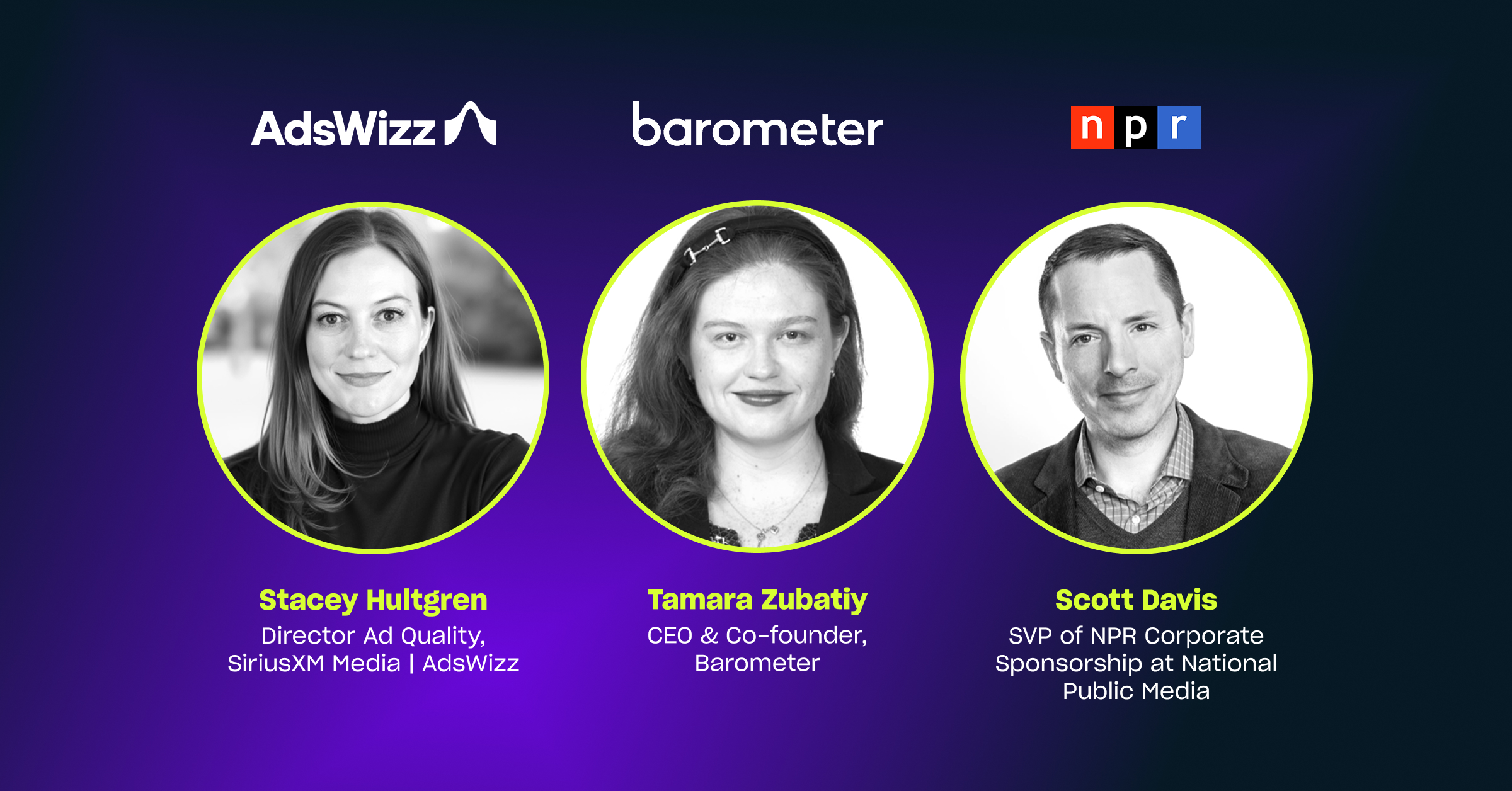
This is something we explored in our recent webinar, Scaling Podcast Advertising: Unlocking Growth with Context and Confidence, alongside Tamara Zubatiy, CEO and Co-founder at Barometer, and Scott Davis, SVP of NPR Corporate Sponsorship at National Public Media. The takeaway was consistent: scale isn’t the issue, activating it is.
From that discussion, a few key themes emerged.
The misconception holding podcast advertising back
This is where one of the biggest misconceptions in the space comes into play. There’s still a tendency to think that scale in podcasting is limited, when in reality what’s limited is how campaigns are activated. Most investment continues to cluster around a relatively small group of well-known shows. While that approach feels safe, it also narrows the view of what the ecosystem actually offers.
As Tamara pointed out, a lot of this comes down to visibility and understanding. Advertisers aren’t necessarily avoiding the long tail because it lacks value, they’re avoiding it because they don’t have enough clarity into what’s there.
That leaves a large pool of high-quality content underutilized, even though it’s reaching engaged audiences every day.
When protection becomes overblocking
That hesitation often shows up in how brand suitability is managed. Protecting a brand is obviously critical, but the tools used to do that can sometimes be too broad for the way podcast content actually works. Entire categories are often excluded in one move, with news being a common example (more on that later).
The issue is that podcast content is fluid episode to episode. Tone, context, and subject matter can shift from one episode to the next. When those nuances are ignored, suitable content gets filtered out alongside content that might genuinely raise concerns.
That’s where overblocking starts to have a real impact:
- Reach is reduced
- Suitable content is unnecessarily excluded
- Publishers lose monetization opportunities
- And the actual level of risk doesn’t meaningfully change
It creates the impression that scale and brand suitability are in conflict, when the real issue is how content is being evaluated.
Why show-level targeting falls short—and what comes next
It’s natural to think of a podcast as a single environment, but in practice, each episode can be very different. A show might move from a light, conversational interview to breaking news coverage to a sports recap over the course of a week. Each episode carries its own tone and context.
During the webinar, I shared an example of an advertiser running on Conan O’Brien Needs a Friend. The show was a strong fit, but one episode raised suitability concerns. Without a more granular approach, the only real option was to reconsider the entire show.
For publishers and networks, adjacency concerns can cut entire shows or categories, even when most of the content is appropriate. The issue isn’t the show, it’s a single moment within it.
That’s where episode-level evaluation comes in.
Instead of assessing a show as a whole, it focuses on the specific episode where an ad will appear. It gives a clearer view of tone, sentiment, and context, which is what advertisers actually care about—and better reflects how listeners engage with podcasts.
With that level of precision, advertisers can:
- Keep suitable content in play
- Filter out risk more effectively
- Expand reach without losing control
That’s what starts to rebuild confidence.
How AdsWizz and Barometer make this actionable
Bringing that level of precision into the buying process requires the right infrastructure.
Through the AdsWizz and Barometer integration:
- Episodes are transcribed and analyzed
- Context, tone, and sentiment are evaluated
- Suitability signals are applied before an ad is served
As Tamara explained, having this happen before an episode is live is critical. It allows advertisers to make decisions in real time, rather than reacting after the fact. That timing is important. In podcasting, a large portion of listening happens shortly after an episode is released. If evaluation happens too late, valuable impressions are already gone.
NPR Shows what this looks like in practice
NPR was highlighted as a clear example of how this approach works in practice. Scott shared how, without the right technology in place, strict suitability requirements made it difficult to fully activate inventory, particularly across news content, where adjacency concerns tend to be highest and the margin for error feels smaller.
That’s where things start to change with episode-level, pre-release evaluation. Instead of broadly avoiding news, advertisers can make more precise decisions about where their ads appear, which means they can stay in high-demand environments without taking on unnecessary risk.
Advertisers can activate with confidence from the start, and publishers can make more of their inventory available without compromising standards. It also means advertisers don’t miss that initial wave of listening, when audiences are most engaged, which is often where the most value sits.
Scale isn’t missing. It’s waiting to be activated
What this ultimately comes back to is a shift in perspective. Podcasting doesn’t lack scale. The challenge is activating it in a way that feels controlled and intentional. When evaluation is too broad, opportunity gets filtered out. With greater precision comes greater confidence, more usable inventory, and a clearer path to scale.
Want to go deeper into the conversation? Watch the full webinar below.
Thinking about how to apply this to your own campaigns? The AdsWizz team is always happy to talk it through. Let’s chat!
By Stacey Hultgren, Director, Ad Quality at AdsWizz and SiriusXM Media