Every September, DMEXCO turns Cologne into the center of Europe’s digital marketing industry. This year, it brought more than 1,000 speakers to 17 stages under the motto “Scaling Intelligence,” a challenge to stop experimenting with AI and start putting it to work. And audio makes a good test case for that idea.
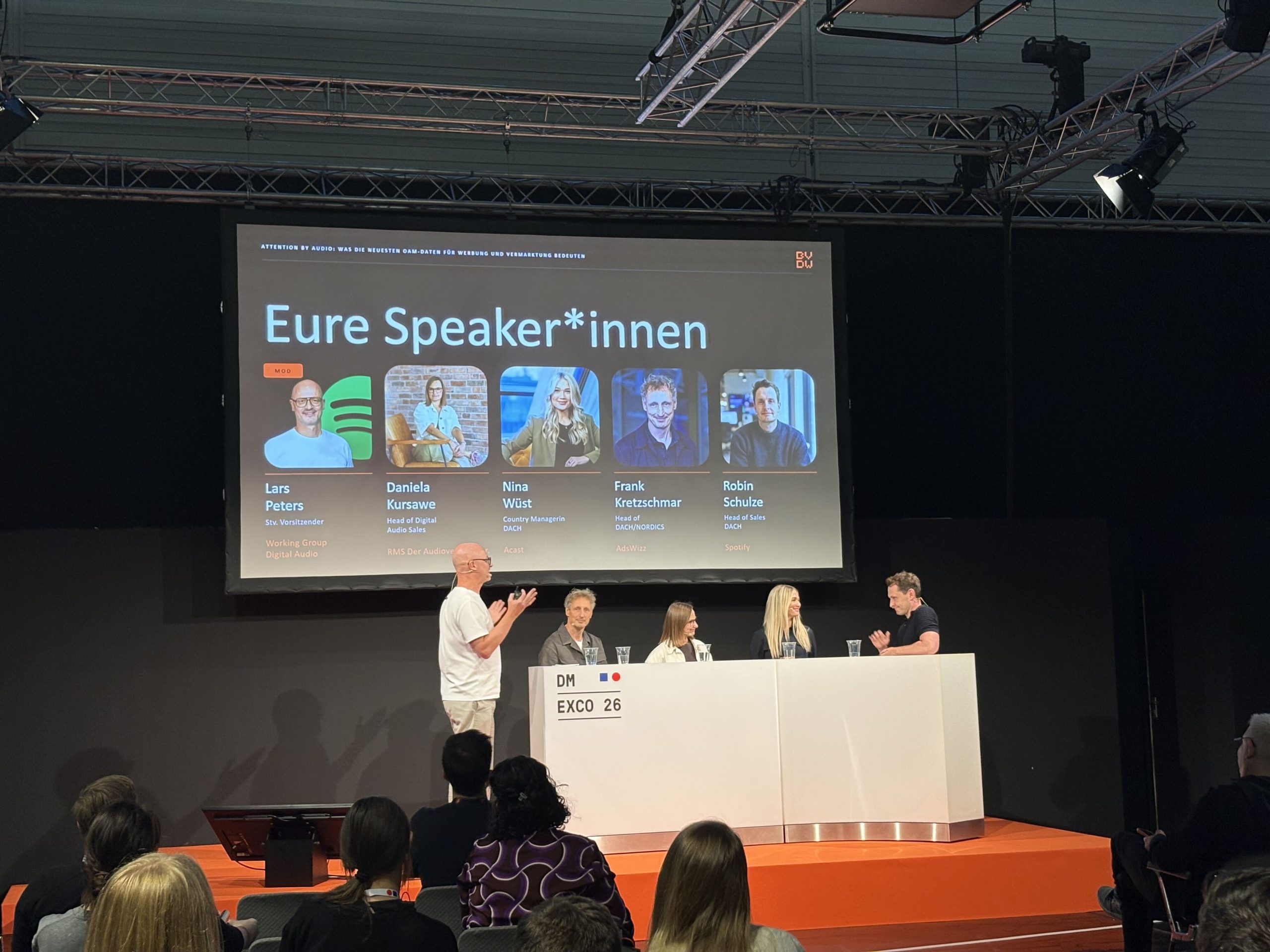
I got to put it to the test when I joined the panel for a BVDW Masterclass on the Online Audio Monitor 2026, alongside four other leaders from across Germany’s audio market:
- Dr. Lars Peters, Senior Podcast Monetization Lead, Spotify (moderator)
- Daniela Kursawe, Head of Digital Audio Sales, RMS
- Nina Wüst, Sales Director DACH, Acast
- Robin Schulze, Head of Sales, DACH, Spotify
The session centered on a simple question: How do people listen now, and what does that mean for the brands trying to reach them? The discussion kept landing on one conclusion. Audio has reach and scale, and the brands that win will be the ones that plan around how and where people listen.
The Online Audio Monitor, Germany’s annual study of how people use online audio, backs that up. Audio is now a daily habit for most respondents, the competition for listeners is spreading to connected cars and smart TVs, and context has become as important as reach. Each of those shifts changes how audio should be planned and bought.
Audio reaches three in four Germans, so plan it as one buy
Start with the numbers. The study puts online audio’s reach at 53.4M people in Germany, roughly three in four people aged 14 and older. Among 14- to 29-year-olds, it’s 93%. Music streaming leads with 66% reach, followed by web radio at 54%, podcasts at 34%, and audiobooks and radio plays at 25%.
After years of strong growth, usage has stabilized at a very high level, and six in ten online audio listeners tune in daily or almost daily. That’s what a mature medium looks like, and it should be bought like one. Plan music, podcast, and broadcast audio as one buy instead of three.
AudioMatic, AdsWizz’s DSP, brings audio planning, buying, measurement, and optimization into one platform. Buyers can use insights from one format to improve performance across others, putting intelligence to work with every campaign.
Being found is the new battleground
Radio still owns the car. Among people who use online audio behind the wheel, 84% also listen to radio and 95% say they find the radio easily in thxeir car’s built-in system. On Apple CarPlay and Android Auto, though, radio faces stiffer competition from music streaming and other services.
Cars aren’t the only place this is happening. Listening is concentrating on the two biggest audio platforms, and 20 million people in Germany tune in on their smart TVs. Every one of those screens and apps shapes what listeners hear next, so a plan built around a single platform misses a big share of the audience. Start by mapping where your listeners hear your ads, from phones to connected cars to smart TVs, and check how much of that your current plan covers. Tracking that many entry points by hand doesn’t scale, which is where AI-driven planning comes in.
The pull toward two big platforms also makes reach outside them more valuable, because that’s where a brand can stand out instead of competing for the same ears as everyone else. Through our exclusive SoundCloud partnership in Europe, which covers 14 markets including Germany, brands working with AdsWizz can add SoundCloud’s engaged, diverse audience to the rest of their audio plan.
Context and trust do the heavy lifting
How people listen depends on who they are and what they’re doing, and that idea sat at the center of the Masterclass. Younger listeners tend to pair audio with work, gaming, exercise, or the commute. Older listeners are more likely to listen without doing anything else, and podcasts in particular get that kind of focused attention.

Trust makes that attention worth more. Podcasts stand out for background knowledge and trustworthiness, and 35% of regular podcast listeners call them a primary or even their most important source of information. Web radio carries the weight of familiar broadcast brands, with eight in ten listeners tuning into stations that also air on FM or DAB+, Europe’s digital broadcast radio.
AI is how you act on all of this at scale, matching an ad to the listening moment in near real time without leaning on personal identifiers. AdsWizz’s contextual targeting draws on signals like device, content, and listening environment to decide where each ad runs. That’s what scaling intelligence looks like in audio.
For brands, putting it to work starts with planning around the listening moment:
- Match the message to the mindset. A runner with a playlist needs a different ad than a driver catching the news on the radio.
- Place it in environments listeners already trust, like the radio brands they grew up with or the podcasts they turn to for news.
- Let audience segments refine the buy instead of driving it. Start with the moment, then narrow by audience.
Where audio goes from here
Leaving DMEXCO, I kept coming back to its opening challenge: putting intelligence to work. Audio already has the reach. The opportunity now is to understand how and where people listen, then use that knowledge to plan across platforms and formats as one connected medium.
Want to see what the Online Audio Monitor 2026 data means for your 2027 audio plan? Book a meeting with my team at AdsWizz.
And to go deeper on the signals behind contextual audio, download our guide, Innovative Targeting in Digital Audio Advertising 2026.
by Frank Kretzschmar, Head of DACH/Nordics